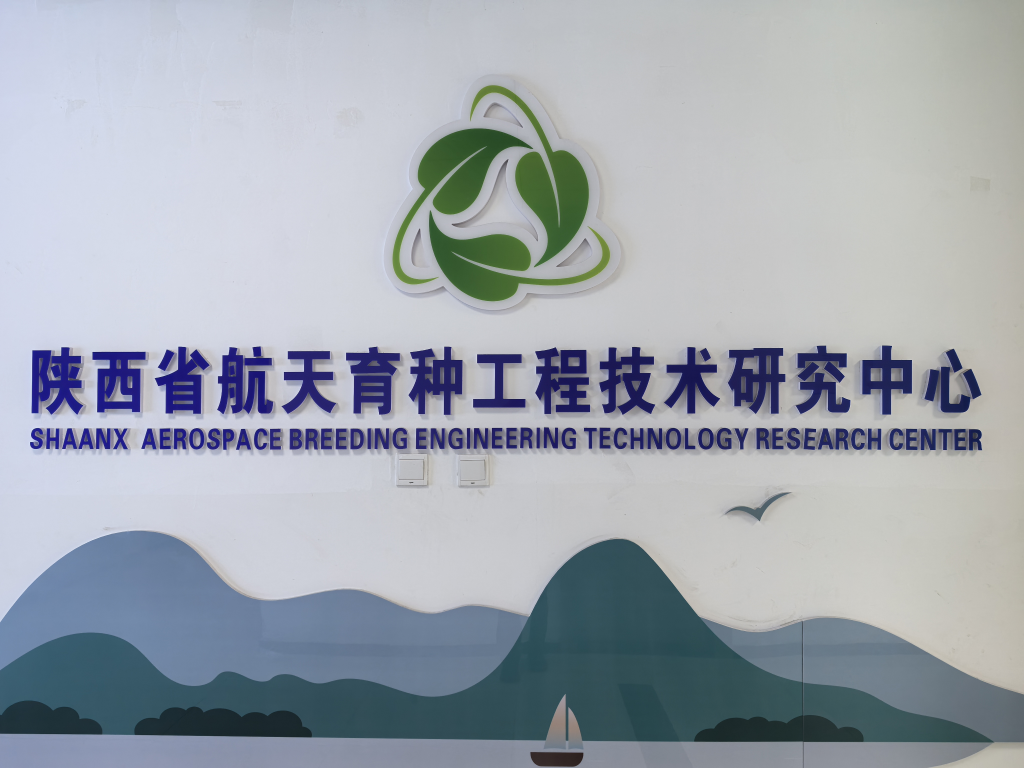
The Shaanxi Aerospace Breeding Engineering Technology Research Center is a provincial-level scientific research institution approved by the Department of Science and Technology of Shaanxi Province. Its primary mission is to develop novel plant germplasm with superior quality, stress tolerance, and high yield through space-induced mutagenesis, integrating molecular and conventional breeding techniques. Thecenter also focuses on the efficient evaluation and identification of space-mutagenized germplasm resources and the engineering application of new variety development. Multiple specialized laboratories have been established, including those for cell engineering, genetic engineering, and microbial engineering. In addition, three ground-based space breeding selection and demonstration bases have been constructed in Chang'an District of Xi'an, Yangling Demonstration Zone, and Hanbin District of Ankang City.
Centered in Shaanxi and oriented toward the whole country, the Center actively promotes international exchanges in space breeding technology with countries and regions involved in the Belt and Road Initiative. It maintains a longstanding commitment to education, scientific research, demonstration, and extension in the fields of space agriculture and space breeding. Cooperative partnerships have been forged with numerous localities, including Yuyang District, Dingbian County, Jingbian County, Mizhi County, Liuba County, Yang County, and Zhenba County in Shaanxi Province,among others.
In 2024, China's first high-altitude cold-region forage grass breeding and demonstration base was established in Cuona, Tibet, at an elevation of 4,680 meters. Committed to international collaboration, thecenter employs space agriculture technologies and space-bred cultivars to serve countries along the Belt and Road, and has engaged in exchanges and cooperation with Belt and Road partners including Indonesia, Malaysia, Egypt, Kazakhstan, Pakistan, Iran, and Mongolia. It has also participated in and co-organized multiple sessions of the Belt and Road International Symposium on Biologically Healthy Agriculture.
The Center places particular emphasis on the selection and breeding of critical biodiversity resources and local germplasm in western China and undertakes tasks related to the optimization and improvement of tree and grass species for the Three-North Shelterbelt Program. A wide array of distinctive breeding materials have been carried into space, including Dahongpao pepper from Chengcheng County, Mizhi millet, Xingping Qin pepper,Psathyrostachys huashanica(a national first-class protected plant), windbreak and sand-fixing species native to Northwest China such as sea buckthorn, wolfberry, and yellowhorn, the Cangjie hand-planted cypress, and microbial strains for ecological restoration screened from the Qinling mining area.
The Center has published four monographs—A Brief History of Space Breeding,China's Ambition: Space Technology for a Green China,China's Seed Industry, and The Fantastic Journey of Seeds—which have received national accolades including "China's Good Book" and "National Excellent Popular Science Work." Since 2019, it has continuously implemented the "Space Agriculture for Rural Revitalization in One Hundred Counties and One Thousand Villages" initiative and themed activities under "Space Agriculture: Future Countryside." It has organized and contributed to the formulation of national group standards such as General Technical Requirements for Space Ecological Agricultural Products (Ecological Ingredients).
In 2024, the Center was invited to participate in the special eventNight of SpaceTV show on CCTV. In 2025, it was featured in a special report on new quality productive forces by Xinhua News Agency. A space agriculture science popularization and education base has been established around the Engineering Research Center, which has been officially designated as a science education base at the provincial, municipal, and district/county levels.
Personnel List:Guo Rui, Tian Aimei, Yu Xiaofeng, Zhang Jiudong, Zhao Yongmei, Yu Bing, Du Xichun, Xu Weijun, Su Liyan, Du Guorong, Xu Jing, Li Jing, Meng Changjun, Liu Xiaoxiao